September 16, 2006

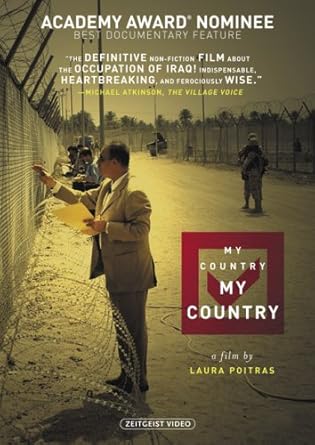
My Country, My Country

Directed by Laura Poitras
Reviewed by Martin Tsai
A documentary on Iraq’s 2005 election, Laura Poitras’ My Country, My Country presents a viewpoint too rarely seen in the slew of news coverage and other documentaries on the war that ravaged nation. Unlike Gunner Palace, The War Tapes and The Ground Truth – which all spotlight American troops – Poitras’ film follows the six-month campaign trail of a Sunni candidate running for the Governorate Council of Baghdad.
An all-around nice guy, Dr. Riyadh goes out of his way for patients at the Adhamiya Free Medical Clinic, even lending money to a woman whose husband is unemployed. Although he is critical of American secularism, Riyadh believes that it's crucial for his fellow Sunnis to participate in the election so they can have their say in the all-important drafting of the constitution.
Chaos is still ubiquitous in Baghdad two years after the U.S. invasion, when the docu is set. There’s no water or electricity as shootings and bombings continue. At the Abu Ghraib Prison, an inmate has stayed for over a year without getting a hearing, while another is only nine years old. Inspecting the prison, Riyadh can only shrug his shoulders and say to the grumpy inmates: “We’re an occupied country with a puppet government. What do you expect?”
Just three months before the election, the U.S.-led Fallujah offensive leads to the decision by Riyadh’s Iraqi Islamic Party to withdraw all of its candidates. With the deadline for withdrawal already past and the ballots printed, Riyadh continues to rally the Sunnis’ vote amid much resistance. One of his family members says: “Politics are not good for you. You do more good as a doctor for us and other people.”
My Country is a possibly unprecedented story, told almost entirely from the Iraqi perspective. Riyadh’s tale is fascinating, especially when seen alongside those of the U.S. soldiers related in the numerous other documentaries on the Iraq War. This engrossing film unfolds with captivating dramatic tension, which builds all the way up to the climactic election day.
Riyadh’s journey allows Poitras tremendous access into areas mostly untapped by Western journalists, such as a meeting of Iraqi Islamic Party members. She counterbalances Riyadh’s views by featuring vignettes involving U.S. military personnel, U.N. officials, Australian security subcontractors, Kurdish militia, etc.
The documentary still appears to be somewhat one-sided since even the seemingly pro-Bush Kurds criticize the fact that things are not getting better under the U.S. occupation. In one very telling digression, a U.S. official tells the Iraqi election police that they have “the front row of one of the best shows that are gonna be in the world.” Then an election policeman with a puzzled look raises his hand and asks “Election for show?” Riyadh in another scene asks someone whom she’d vote for, and she flatly replies “Saddam Hussein”.
The film comes off a bit like Secret Ballot, due to its focus on Riyadh’s tireless promotion of democracy. Unfortunately, My Country fails to fully illustrate its political backdrop. The docu clocks in at only 90 minutes, so there would seem to have been ample room for a more expansive take. Poitras doesn’t really explain where the Sunnis fit in relation to the Kurds, the Shia, the Arabs and the Turks. Another problem is the film's conclusion, which could be somewhat misleading to viewers who haven't closely follow the news.
Even so, despite shortcomings, My Country is essential in venturing into new fertile grounds that arguably no journalists or filmmakers have previously explored.
Reprinted from EmanuelLevy.com. © Copyright 2006 Martin Tsai. All rights reserved.

August 11, 2006

Three Times

Directed by Hou Hsiao-hsien Starring Shu Qi and Chang Chen
Reviewed by Martin Tsai
If you haven't seen Flowers of Shanghai and Taiwanese auteur Hou Hsiao-hsien's other movies when screened in Seattle, Three Times serves as a fitting introduction to his body of work. Indeed, you could call it Hou Hsiao-hsien for Dummies. Set in three different periods, this triptych about love, time, and fate encapsulates the moods and preoccupations that have inspired him throughout his career. In each chapter, Chang Chen (Crouching Tiger, Hidden Dragon) and Shu Qi (The Transporter) portray three different couples, each pair with a unique dynamic reflecting the era.
A reminiscence about the simpler times of Hou's youth, the 1966-set "A Time for Love" follows a lovesick young man as he searches for a demure billiards parlor attendant during his military leave. Revolving around a 1911 brothel (à la Flowers), the silent chamber drama "A Time for Freedom" recounts the hopeless affair between a courtesan and a married revolutionary whose principles compel him to reject concubinage. In the vein of Goodbye South, Goodbye and Millennium Mambo, the fluorescent-colored "A Time for Youth" explores the fleeting physical intimacy shared by two soulless Gen-Y'ers in an emotionally vacuous 2005, when everyone is venting discontent via cell phone rants, text messages, and e-mail.
Through repetitions and variations, Hou again explores how the shifting times may ripple the surface of life, but not our deeper need for bonding. Each of the three stories is a mini-masterpiece in its own right, as we see innocence, doom, and desperation played out. Each segment has its own rhythm and visual vocabulary: slow motion for 1966, fades for 1911, and tracking shots for 2005.
For those who've previously complained about Hou being too slow and austere, the bite-sized structure helps make Three Times more digestible. It may also send viewers to their DVD players with new insight regarding Hou's back catalog. From this perspective, even more politically charged works such as City of Sadness or The Puppetmaster appear to be portraits of a people adapting to different historical circumstances. And while Three Times can be seen "only" as a collection of love stories, they may add up to possibly the definitive treatment of Taiwanese life—today, yesterday, and the day before that.
Reprinted from Seattle Weekly. © Copyright 2006 Martin Tsai. All rights reserved.

June 30, 2006

The Hidden Blade

Directed by Yôji Yamada Starring Masatoshi Nagase
Reviewed by Martin Tsai
Don't be fooled by the title—Blade isn't the sort of Zatoichi variant it suggests. Rather, it's a revisionist and demystifying samurai saga. In 1861, at the end of the Japanese feudal era, the last samurai are clumsily adapting Western artillery and military formations without the assistance of Tom Cruise. Disgraced since his father's hara-kiri, Katagiri (Masatoshi Nagase of Mystery Train) impetuously rescues his former maid (Takako Matsu) from an abusive marriage, then dutifully abides by the caste system to suppress his affections for her. Meanwhile, he must prove his own innocence by dueling with a school pal accused of treason. Devoid of action until the climactic showdown, Blade is a stately yarn with slow-burn tension and heartwarming romance. But director Yôji Yamada already made the shogun equivalent of Unforgiven with the Oscar-nominated The Twilight Samurai. Though both are adaptations of Shuuhei Fujisawa novels, this follow-up pales slightly in comparison.
Reprinted from Seattle Weekly. © Copyright 2006 Martin Tsai. All rights reserved.

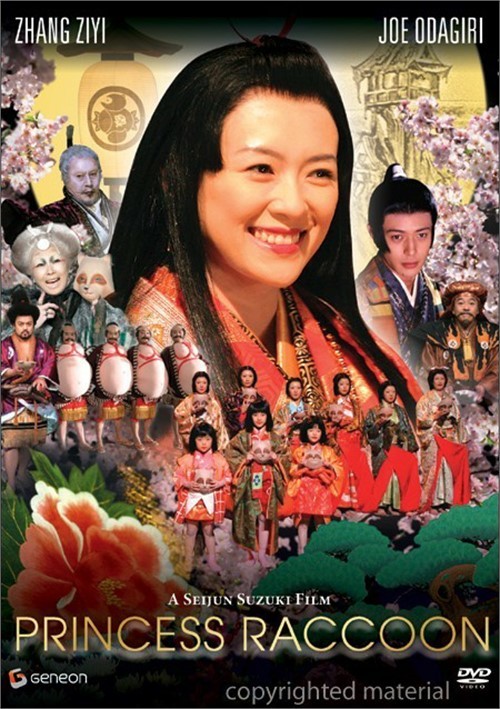
Princess Raccoon

Directed by Seijun Suzuki Starring Ziyi Zhang and Jô Odagiri
Reviewed by Martin Tsai
The Japanese studio system banished him for a decade for making such delirium-addled B-movie classics as Tokyo Drifter and Branded to Kill, but 82-year-old Seijun Suzuki is still as bizarre and irreverent as ever. Raccoon is the seemingly timeless star-crossed romance between a royal raccoon (Ziyi Zhang) and a human prince (Jô Odagiri of Bright Future), exiled for fear that he would supplant his father as the fairest of them all. With Suzuki at the wheel, it's The Umbrellas of Cherbourg with kimonos and psychedelia. The film is a pastiche of Japanese opera, Greek tragedy, and French new wave. Like a continuity editor's worst nightmare, its mise-en-scène alternates inexplicably between theatrical stage, naturalistic exterior, and scroll-painting-superimposed blue screen—sometimes all within the same scene! The musical repertoire likewise covers as many genres as a season of American Idol. Ultimately, Raccoon demands and rewards the total suspension of disbelief. Its incongruous storytelling style takes some getting used to, but beneath lies a mischievously droll and sweet fable that'll leave you with a beaming smile.
Reprinted from Seattle Weekly. © Copyright 2006 Martin Tsai. All rights reserved.

April 02, 2006

Heading South

Directed by Laurent Cantet Starring Charlotte Rampling

Reviewed by Martin Tsai

Colonialist attitudes are still prevalent in the West even as actual colonies become a thing of the past. From politics to entertainment, the portrayal of foreignism variously conjures up exoticism, mysticism, pity, or fear. Laurent Cantet’s Vers le sud confronts these reflexive notions among its affluent protagonists and, by extension, its audience. Set in 1978, the film explores sex tourism in Haiti during the last days of the Duvalier. Sex-starved North American women of a certain age flock to the country for hot summer flings. They might not be exceptionally attractive by our ageist standards, but in Haiti they effortlessly score the objects of their desires simply by virtue of being atop the class hierarchy. Through conversations and interactions, their ignorance, stereotyping, objectification and hypocrisy vis-à-vis the locals casually emerge.

“At home black guys don’t interest me. It’s different here because they are closer to nature,” says Ellen (Charlotte Rampling), an acid-tongued 55-year-old Wellesley professor who has made annual trips there for six years . She takes up with the stunning and charismatic Legba (Ménothy Cesar), and chastises another tourist for dressing him like “black guys in Harlem.” Little does Ellen know that beneath the façade of an innocent island youth, Legba leads a dangerous life that embodies the worst stereotypes she has projected onto African Americans. Given her background and stature, her decidedly un-P.C. assertions regarding the locals threaten to take viewers aback. Most films in the West that involve foreignism simply gloss over this colonialist mindset and unwittingly perpetuate it.

Haitian hustlers here are eager to subject themselves to the tourists’ patronage in exchange for free meals, gifts and cash. Their dependency is reminiscent of third-world women practically throwing themselves at GIs in Vietnam/Korean war flicks. Those women’s American dreams reaffirm notions of Western superiority. Since men typically assume the roles of providers to whom women naturally cling both on and off screen, the scenario’s gender reversal in Vers le sud underscores racial and class disparity. Another sharp contrast is the fact that Legba shows no inclination for pursuing life, liberty, and happiness in the States.

Ellen’s maternal instincts take over, and Legba becomes her charity case. He eventually flares up and tells her, “You’re not my mother.” His reaction repudiates a certain liberal view that the underprivileged necessarily welcome attempts to inculcate instill in them the supposedly higher living standards and loftier values of their benefactors. This kind of humanitarian bent generally appears to be something noble, from the documentary Born into Brothels to the dramatic The Interpreter. Still, the efforts can seem patronizing all the same. Only a few films, like Manderlay and Vers le sud, actually address how these initiatives backfire when well-to-do protagonists fail to recognize the full scope of problems or the repercussions of their actions. In instances involving third-world deprivations such as the one here, there is always some subconscious colonialism on the part of the first-world protagonists in presumptuously appointing themselves saviours.

Cantet’s film addresses its characters’ remorse over the poverty in Haiti as well as the self-serving motives behind their charity. Attention from the irresistible Legba is the tonic that boosts Ellen’s ego, but she only asks him to join her in Boston after he gets in trouble. And viewers can safely conclude that black men ultimately don’t fit in her scene back home. Most other films entitle their protagonists to this kind of self-absorption instead of examining it. The Constant Gardener is about personal mission, global conspiracy, and inflicting liberal guilt onto viewers by depictions of a poor and unruly Africa, and it broaches the outrageous events in Kenya only to embellish the magnitude of the corporate villain’s callousness and the saintly martyrdom of Rachel Weisz’s character Tessa. Its protagonist (Ralph Fiennes) hardly interacts with the Kenyan populace at all.

Vers le sud is not without its flaws. It occasionally seems like a poor imitation of a poor film, Casa de los babys, which has a group of American women in Mexico looking to adopt orphans. Like Sayles, Cantet tells the story through the dissimilar perspectives and experiences of a diverse group of characters in a very precise setting. But instead of gracefully shifting through the various viewpoints, he and co-writer Robin Campillo devise first-person confessionals—complete with title cards—with the characters directly addressing the camera. In a monologue both titillating and repulsive, recently divorced Southerner Brenda (Karen Young) tearfully recounts propositioning the then 15-year-old Legba and reaching her first orgasm at the age of 45 during her first visit to Haiti with her husband three years previous. While at times revealing, these vignettes are redolent of something from an amateurish daytime-TV movie of the week.

Albert (Lys Ambroise), maître d’hôtel at the beach resort where the ladies stay, is the only Haitian character with a narrative voice. His father fought against the first American occupation in 1915 and told him “white men are lower than monkeys.” Albert observes the skin trade from a much different angle than the tourists. He asserts that dollars are far more damaging than cannons, and his trepidation turns out to be quite prophetic. Although the film primarily concerns the tourists’ narrow point of view, the omission of Legba’s narrative voice is incomprehensible considering that Albert gets his say.

With Ressources humaines (1999) and L’emploi du temps (2001), Cantet has established a reputation due to his penchant for the clash between professional and personal identities. Both films address the modern phenomenon of corporate downsizing in his native France and its complications on personal and family lives. But his latest signals a deliberate change of pace: This first try of his at a literary adaptation tackles three short stories by Haitian-born author Dany Laferrière that bare no resemblance to the milieu of the director’s previous work. The only connection here to his past thematic threads is the fact that Legba’s professional life is almost illusionary, and his reality outside the resort is harsher than any of his benefactors can imagine. It recalls Aurélien Recoing’s character Vincent desperately keeping up the appearance of employment in L’emploi du temps. But Vers le sud isn’t Legba’s story at all.

Cantet illustrates Haiti with a neutral approach, without fashioning it as some sort of dangerous, savage land as Meirelles did with Nairobi in The Constant Gardner and Rio in City of God. Still, Vers le sud almost trivializes its devastating historical and political backdrop. Perhaps reflecting the tourists’ naiveté and the resort’s insular nature, the film references atrocities only in passing (a cop bullying a street vendor, a mention of the lavish nightly feast at the presidential compound, an unfathomable assassination). Cantet’s previous features show he’s capable of more complex context and richer characters. With its moral ultimately turning out to be something as trivial as the prologue’s contention that everyone necessarily wears a mask, the film has unfortunately missed the mark amid weightier and worthier subject matter.

From Cinema Scope No. 25, Spring 2006. © Copyright 2006 Martin Tsai. All rights reserved.
February 17, 2006

Freedomland

Directed by Joe Roth Starring Samuel L. Jackson and Julianne Moore

Reviewed by Martin Tsai

Hollywood types have their minds on race relations these days, as evidenced by the emergence of Crash as a bona fide Best Picture Oscar contender. Clockers author Richard Price’s novel Freedomland, which revolves around a white kid gone missing in the projects and the ensuing racial discord, is receiving opportune big-screen treatment. Under the direction of part-time helmer/fulltime studio honcho Joe Roth, the film feels like a generic whodunit attempting to pass as a weighty Spike Lee joint or a Jonathan Demme social weepie.

It’s every parent’s worst nightmare and then some: Her four-year-old son was sitting in the back seat when a carjacker sped off with her vehicle. Brenda (Julianne Moore) describes the perpetrator as a black man, thus leading to a standoff between the residents and the predominantly white police force. Det. Council (Samuel L. Jackson) knows his way around the ’hood, and tries to stem a potential riot while sleuthing for a suspect and the missing child. But Brenda’s hotheaded cop brother Danny (Ron Eldard) interferes with Council’s investigation and intervention while also betraying her shady past.

Originally slated for a late-’05 release complete with a campaign built around Moore’s central performance, the film ultimately sat out the crowded awards season. Moore is indeed powerful, but she does little to salvage this generic and rather unconvincing mystery halfheartedly dressed up as social inquiry. The film ponders racial profiling and police brutality every time its plots stall. While its take on race is more substantial than the parade of animated caricatures in Crash, Freedomland still comes off as inconsequential due to its laughably absurd resolution.

© Copyright 2006 Martin Tsai. All rights reserved.

January 27, 2006

Imagine Me & You

Directed by Ol Parker Starring Piper Perabo, Lena Headey and Matthew Goode

Reviewed by Martin Tsai

Gay cowboys aren't the only ones who wish they knew how to quit each other. Apparently so do "dygetarians" AKA "lesbifriends", as alleged in the Brit rom-com Imagine Me & You. These homos can only be happy together behind the backs of their hapless spouses. On her walk down the aisle to marry gormless stiff Heck (Matthew Goode; no, not the rocker), Rachel (Piper Perabo) and floral designer Luce (Lena Headey) exchange goo-goo eyes. Luce yearns for Rach to come to her window while everyone else obliviously tosses off obligatory gay jokes, i.e. "she's gay as a tennis player". Rach is soon thinking about the girl she loves day and night, and inevitably faces the dilemma of whether to follow her heart or … really, what else would anyone follow in this post-1963 day and age?

Imagine is like When Night is Falling as re-written by Richard Curtis. Every character speaks with that toffee-nosed Hugh Grantish sarcasm. There's the ghastly wedding scene complete with embarrassing speeches and the wankiest pop oldies, à la Curtis's Four Weddings and a Funeral. By the way, can we please annul all this unholy movie matrimony. Wasn't Nia Vardalos's ethnic nuptial circus more than enough? Anyway, Imagine is full of cute foreshadowing and clichéd coincidence (for example, Rach rings Luce and hangs up without saying anything, then Luce hits the redial button and wouldn't you know that poor Heck answers). Really, how much pride, prejudice, sense and sensibility are we supposed to stomach?

Bottom line is, Imagine lacks the charm supplied by Grant or Colin Firth. It doesn't even have cowboys doing the Jack Twist (or Jack Nasty if you will). Exactly a decade ago the Wachowski brothers made Bound, which had a similar setup except the married woman got her lesbo lover to steal from the husband. Bound is arguably one of the best gay-themed films because sexuality is completely irrelevant to the plot, and the queer characters are no different from regular folk. The essential problem with the likes of Imagine and Brokeback Mountain is that they are gay films made by heteros for heteros. They purport to be sympathetic toward homosexuals, yet unwittingly cast them into the stereotype of selfish home wreckers. These films are exploitative if not downright fraudulent.

© Copyright 2006 Martin Tsai. All rights reserved.