Showing posts with label 44th New York Film Festival. Show all posts

October 22, 2006

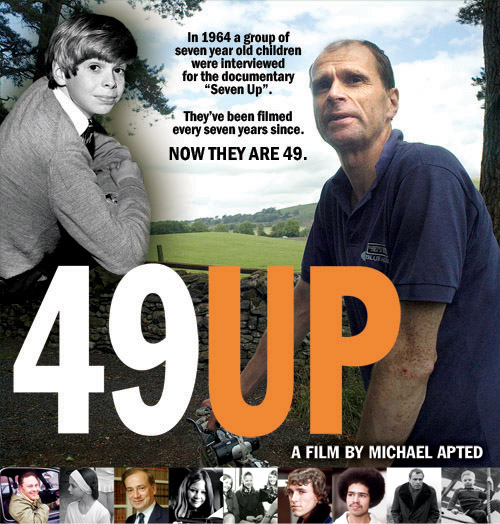
49 Up

Directed by Michael Apted

Reviewed by Martin Tsai

Exploring the impact of class difference on the lives of 14 seven-year-old school children, the groundbreaking 1964 documentary Seven Up! became a cultural landmark in its native England when it first aired. Director Michael Apted has been documenting those lives ever since, following up on them every seven years with a new installment. Through the various films, viewers witness each participant’s innocent childhood, carefree adolescence, hard-fought adulthood, and painful midlife crisis.

The latest, 49 Up, is the first to hit American shores. The 12 subjects (two of the original 14 dropped out in their 20s) have all pretty much given up their lofty ambitions, reconciled with past troubles, and settled for life’s rewards on a relatively lesser scale. Juxtaposing current looks at the 12 with archival footage from previous installments, the film puts life – both theirs and ours – in perspective. It shows how one can turn from a chubby-faced child to a wrinkled grandparent quite literally in a flash.

John and Andrew went to the pre-prep school and predictably grew up to be barristers. Working-class Jackie and Sue went through jobs and marriages, and became single parents. Bruce showed an early sensitivity toward poverty and racial issues, and wound up teaching kids in Bangladesh. Tony failed at being a jockey in his youth and did a string of odd jobs. Nick transcended his early years on the farm and became a nuclear physicist in the States. Neil was unemployed and homeless throughout his 20s and 30s, and later recovered to become a district councilor. It’s mind-boggling to see how some of them remain essentially the same people and achieve their childhood goals, while others have weathered life and emerge completely different.

What started out as a commentary on the class system has morphed into something far more profound. No class is immune from failed aspirations, broken marriages and the joys of parenthood and grandparenthood. The film’s social commentary reaches even further beyond the lives of its subjects: As they move into posh suburbs or promised foreign lands, East Indian immigrants have taken over their old East End neighborhood.

The film is also no longer Apted’s. Feeling that the series has invaded their privacy and their dirty laundry has become water-cooler gossip, many participants start to take the reins of their own narratives by withholding information or questioning the voyeuristic nature of the project. Some of them pointedly accuse Apted of projecting his middle-class worldview onto the series, while others suspect an ulterior motive behind his questions.

Objectively, one can argue that Apted is in a way still projecting his own view in spite of his objects’ attempt to exert control over the depiction of their lives. The 65-year-old filmmaker is possibly facing the issue of mortality, and 49 Up seems to be putting more emphasis on children and family life. But it’s also possible that this entire generation has already fought its battles, and they now just want to live out the remainder of their lives in comfort and contentment.

There are few documentaries or even dramatic films that are able to articulate life quite like 49 Up. This is not just a slice of life, but life in its entirety. Encompassing class, money, marriage, sex and parenthood, the film tells the story of the post-war, baby-boomer generation like few others could. In the age of the so-called reality television when people mug for the camera and blow the most insignificant thing out of proportion, 49 Up reminds us that pure, unadulterated reality is truly quite a spectacle to behold.

Reprinted from EmanuelLevy.com. © Copyright 2006 Martin Tsai. All rights reserved.

October 14, 2006

Marie Antoinette press conference at the 44th New York Film Festival

Photo by Martin Tsai. Marie Antoinette director Sofia Coppola and star Kirsten Dunst at the Alice Tully Hall in New York City on Oct. 13.

By Martin Tsai

“I didn’t know very much about her, except for this iconic decadent evil queen. When I started reading about her, I was struck by how young she was. She was this 14-year-old kid. I read about the side that is a real person, who had a lot of sympathetic qualities as well as flaws,” Sofia Coppola said of Marie Antoinette. “I wanted to make an impressionistic view of her. I wanted all the music to reflect emotions the character was having at that time. I wanted to take the adults in the court and the music of the period and then contrast that with the world of the teenagers and the more contemporary music that shows the energy.”

Since its debut at the Cannes Film Festival, Coppola’s Marie Antoinette has met a lukewarm reception in France. But the film gets a second chance in the States, where it premieres at the prestigious New York Film Festival. At the press conference, Coppola seemed less interested in talking about her use of contemporary music in a period piece. She became more engaging and articulate only when she had to defend some of her historical choices rather than artistic ones.

“There are so many elements, we couldn’t put every single thing in … We couldn’t go into every area because it was an impressionistic portrait,” Coppola responded when journalists asked her why she chose not to show Marie Antoinette’s decapitation and glossed over her illiteracy.

“The story after they leave Versailles is a long period of 10 years in prison and a long trial and then escape,” she said. “We weren’t making a miniseries so I couldn’t tell that whole story. I decided to focus on the years in Versailles prior to her departure, to show that she evolved and became a woman.”

Kirsten Dunst, who plays the title role, finds Coppola’s method is more rewarding to her as an actress than the textbook approach. “Already I knew this would be something different from how I would normally approach a historical figure. (Coppola) forced me to look at her in such a personal way that I had never looked at somebody in history before. There are so many facets about Marie Antoinette. I could have the freedom of my own in trying to find the essence of her, not judge her, and understand her point of view as a woman at whatever stage she might be in.”

Coppola said it was thrilling for the cast and crew to be able to film on location in Versailles, especially in the museum’s private areas. The only issue was for her producer Ross Katz to schedule the filming, since the museum is open to the public most of the time.

“It was a very scary thing going to France and not knowing we would have permission to shoot in Versailles,” Katz said. “After one meeting with the current head of Versailles – the director general of the palace – he said that he was going to open the gates to the palace so we would be able to tell the interior life of the character. From that point on they were with us every day to film at a place that has spoken to millions of people.”

© Copyright 2006 Martin Tsai. All rights reserved.

October 10, 2006

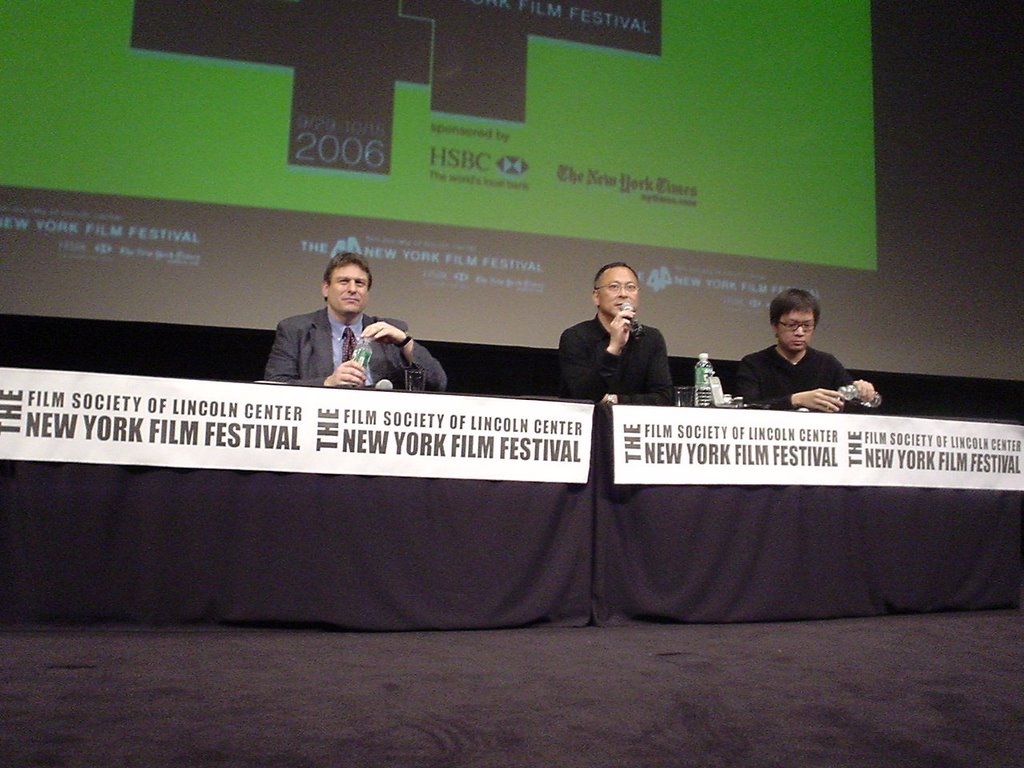
Triad Election press conference at the 44th New York Film Festival

Photo by Martin Tsai. Film Society of Lincoln Center program director Richard Peña, Triad Election director Johnnie To and producer Dennis Law at the Walter Reade Theater in New York City on Oct. 9.

Story to follow.

© Copyright 2006 Martin Tsai. All rights reserved.
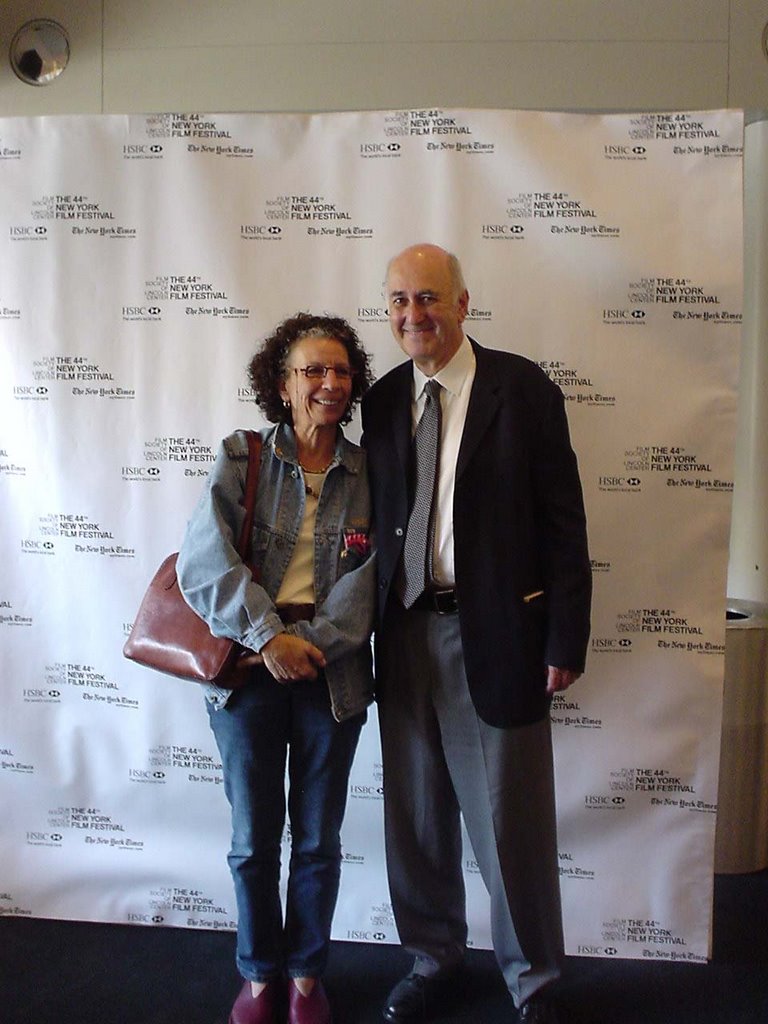
These Girls press conference at the 44th New York Film Festival

Photo by Martin Tsai. These Girls director Tahani Rached and New York Film Festival seection committee member Phillip Lopate at the Walter Reade Theater in New York City on Oct. 9.

Story to follow.

© Copyright 2006 Martin Tsai. All rights reserved.
October 07, 2006

Inland Empire press conference at the 44th New York Film Festival

Photo by Martin Tsai. Inland Empire stars Justin Theroux, Laura Dern and director David Lynch at the Alice Tully Hall in New York City on Oct. 6.

Photo by Martin Tsai. Inland Empire director David Lynch at the Alice Tully Hall in New York City on Oct. 6.

Story to follow.

© Copyright 2006 Martin Tsai. All rights reserved.

Falling press conference at the 44th New York Film Festival

Photo by Martin Tsai. Film Society of Lincoln Center associate director of programming Kent Jones, Falling director Barbara Albert and star Gabriella Hegedûs at the Walter Reade Theater in New York City on Oct. 6.

Story to follow.

© Copyright 2006 Martin Tsai. All rights reserved.
October 05, 2006

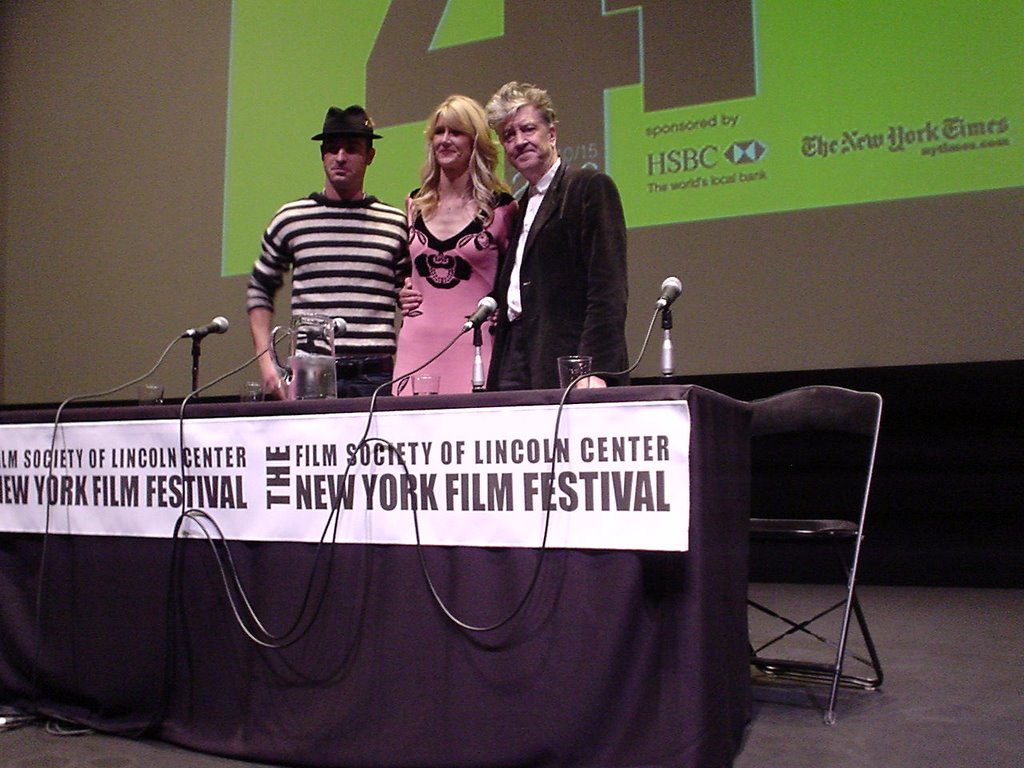
Volver press conference at the 44th New York Film Festival

Photo by Martin Tsai. Film Society of Lincoln Center program director Richard Peña, Volver director Pedro Almodóvar, star Penélope Cruz and executive producer Agustín Almodóvar at the Walter Reade Theater in New York City on Oct. 4.

By Martin Tsai

When asked how he has changed over the years, Pedro Almodóvar replied: “My hair is more white.”

Truth be told, the Spanish auteur once branded by critics as an enfant terrible has mellowed quite a bit over the years. His staple drag queens, druggies and flamboyant gay men are completely absent in Volver.

Penélope Cruz, who worked with him seven years ago on All About My Mother and recently on Volver, said that “Maybe the thing I found a little different in this shoot was he was giving this feeling of peace to everyone on the set. He was very wistful, so relaxed. I care a lot about him so I was happy to see him so happy during the shoot.”

Almodóvar said Volver is about – among other things – maternity and mortality. The story is about a mother reappearing to her two daughters years after her death. It features a clip of Luchino Visconti’s 1951 Bellissima, and Almodóvar thinks that Anna Magnani from that film embodies “the iconography of housewives and mothers in cinema.” In both films, the mothers feel threatened by their more beautiful daughters. Almodóvar said that he isn’t someone who dreams or thinks a lot about his childhood, and didn’t really use his childhood experiences as subjects of his films until the last three or four years. He started to look at things from his childhood more positively – such as the women who raised him – perhaps due to his increasing awareness of his own mortality.

The filming of Volver took Almodóvar back to his birthplace, Castilla-La Mancha, a place for which he once had much contempt. “It gave me the reconciliation I needed,” he said, “because I didn’t like to think about my childhood.” He said that it was the last place on earth he wanted to live, because it was a region that was very reactionary, extremely conservative, and really quite macho in many ways. According to his eyes as a child, the region was against sensuality.

“ ‘Volver’ is a title with many meanings,” Almodóvar explains. “One of the more important things for me was to come back, to return. It was going back to my roots. It was incredible. It was something that I didn’t expect that I’d feel during the shooting. It was to go back to the same place where I was born, where I lived my first eight years, the place where I saw my mother – not in the same way in the movie – and basically how strong she was. I also come back to work with Carmen Maura. We didn’t work together in the last 18 years. And I also go back to work with Penélope. The last time we were here it was seven years ago. Also you know Volver is the title of the CD by Carlos Gardel. ‘Volver’ means also the passing of time … There are some very powerful meanings with this title.”

© Copyright 2006 Martin Tsai. All rights reserved.
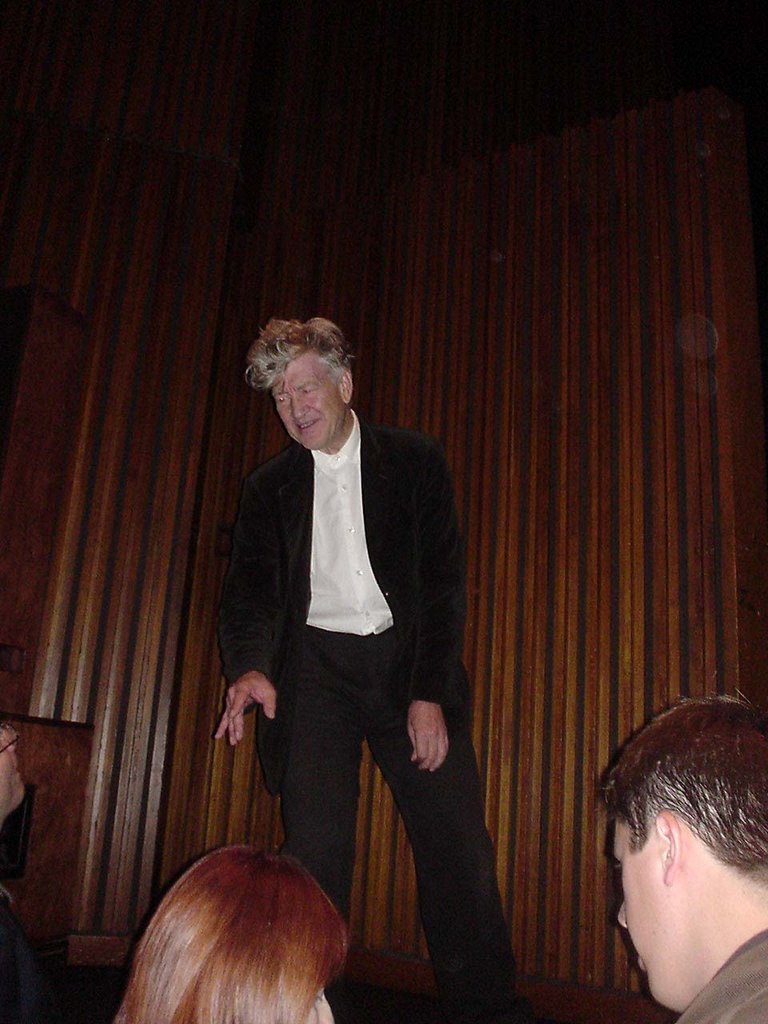
49 Up press conference at the 44th New York Film Festival

Photo by Martin Tsai. 49 Up director Michael Apted, Tony Walker and Film Society of Lincoln Center program director Richard Peña at the Alice Tully Hall in New York City on Oct. 4.

By Martin Tsai

In 1946, Michael Apted got a glimpse of the lives of 14 seven year olds when he worked as an assistant on the landmark British documentary Seven Up! He has been documenting those lives ever since, following up on them every seven years with a new installment. The latest, 49 Up, also happens to be the first to hit American shores.

Apted said the series is the most important he has ever done, and its success has launched his career. His subjects also find themselves household names in England and experience the downside of celebrity. Tony Walker, one of the subjects, said he was surprised when someone stopped him in Central Park and sought his autograph.

“A lot of people had asked me about my marriage problems, which I can honestly say is intrusive. But I accept that because that’s what was happening in that particular time,” Walker said. “That’s why I give a true reflection to Michael. He wanted my honesty, so I try to give him a truthful personal interview.”

With the exception of two, all of the subjects continue to participate in the series. But some of them are also quite cautious about the series’ presentation of them and now demand editorial control. The new film includes a scene in which the subject Jackie Bassett frankly questions Apted’s ulterior motive.

“I’ve always felt that documentaries sort of get off the hook of it. There are some pure depictional problems in that I think documentaries can be as manipulative as anything,” Apted said. “And I always have been aware. I’ve tried to correct it in some ways. I’ve always been trying to avoid projecting my own middle-class insecurities.”

Apted said he does accommodate his subjects so that he can go back and interview them again. For his part, he doesn’t revisit the older films before making a new installment or ask follow-up questions during the interviews.

“They each have a different voice. They each have a different tone to them,” he said. “It is kind of surprising. That’s one of the adventures of doing it. You never know what it’s going to be about until you put it together. So the criterion is what is happening with them now rather than making it a self-fulfilling prophecy. It’s a powerful thing to do, but being able to just think about it is a good exercise to do instead of retread the old stuff just so we can get some answers and make some nice cuts.”

The director said the project began as a reflection on the English class system and the generation that was born in 1956, but now the system isn’t as claustrophobic or suffocating. It has taken him a while to realize that he isn’t making a political film, and there are more personal and universal ramifications like relationships, children, money and sex.

“The real kind of tragedy for Tony and everyone else is that they cannot reinvent themselves. There they are,” Apted said. “I would like to see what I was like when I was seven years old, but if I got caught on the film you would have seen that I was a shy, reserved, cowardly boy … I could do a revisionist history of my life, and I had this vision of me as a seven-year-old boy that is total bullshit that probably you would see as sort of an aggressive alpha male who would go on to make a Bond film.”

© Copyright 2006 Martin Tsai. All rights reserved.

September 28, 2006

The Queen press conference at the 44th New York Film Festival

Photo by Martin Tsai. The Queen director Stephen Frears outside the Walter Reade Theater in New York City on Sept. 25.

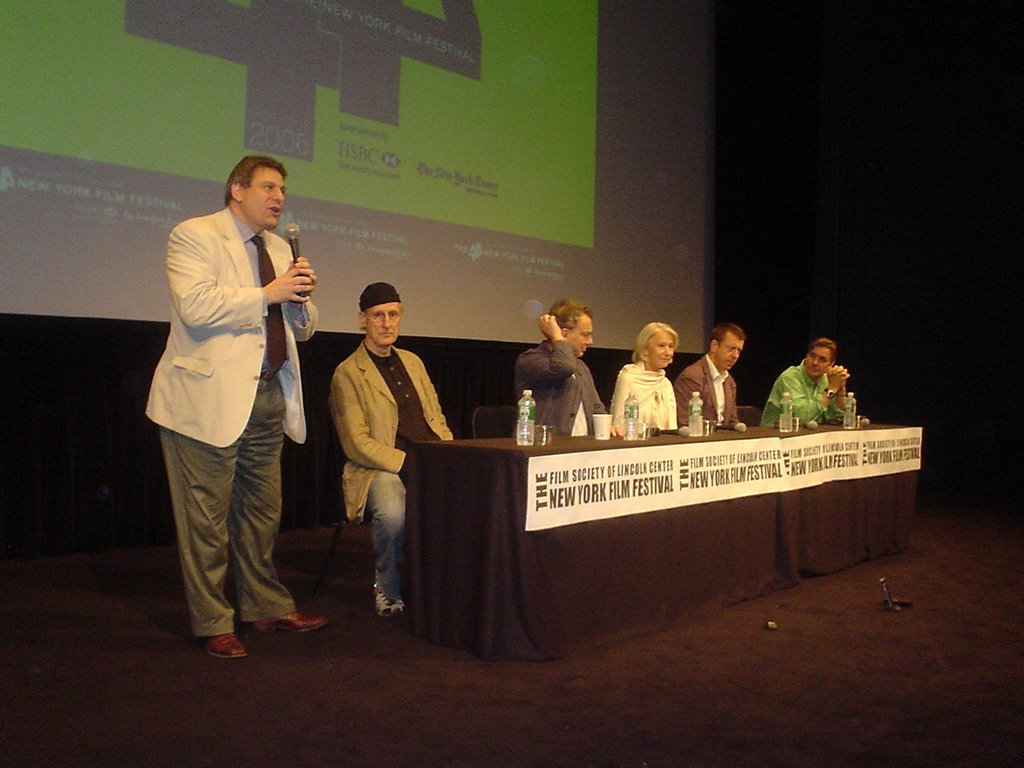
Photo by Martin Tsai. Film Society of Lincoln Center program director Richard Peña, The Queen star James Cromwell, director Stephen Frears, star Helen Mirren, writer Peter Morgan and producer Andy Harries at the Walter Reade Theater in New York City on Sept. 25.

By Martin Tsai

“If you are British, the royal family is very complicated and they are laughed at nonstop. They are in many respects quite ridiculous. On the other hand, you can’t make the film from many positions that don’t contain sympathy for or curiosity about the sort of human beings underneath it all,” director Stephen Frears said. “What’s shocking and controversial about this film is that it takes them seriously.”

Frears’ new film The Queen, which just opened the 44th New York Film Festival, focuses on how the British royal family coped in the aftermath of Princess Diana’s death and the relationship between Queen Elizabeth II and British Prime Minister Tony Blair at the height of his popularity. Though much of the film draws from actual events, screenwriter Peter Morgan imagines the goings on behind the scenes.

“The relationship between the queen and the prime minister has always been the thing that sort of piqued the interest for me,” Morgan said. “The fact that they are in a room together and the fact of them talking about politics or all these meaningless conversations, it immediately has constitutional resonance for me as an Englishman – the idea of putting that kind of power in the same room and the sort of private audience they might have.”

The events depicted here took place nearly a decade ago, and the British public’s opinion of Tony Blair has changed considerably. Although depicting him mostly as a sympathetic character, Morgan illustrates the “conservatizing of Tony Blair.”

“We couldn’t do a hatchet job on him if we wanted to because this was sort of his finest hour,” Morgan said. “For the film to portray him badly would just be irresponsible and inaccurate. He conducted himself extraordinarily well. Having said that, we did look for opportunities to try and express some of that.”

In preparation for the title role, actress Helen Mirren said she read a lot, looked at portraits, watched videos and was lucky to have a wonderful voice coach. “I was very drawn to the queen as a young girl, and spent most of my time researching and watching things from when she was young, before she ever had any slight ideas that she would be the queen. I thought that would probably reveal the true character and her true personality.”

Frears said that his empathy for the queen has probably deepened because of Mirren’s performance in the title role.

Mirren allowed, “Actually, I’m not really a very political person. I think a lot about politics, but I don’t mix with politics. I was happy about Labor coming into power, because it was a change and the change was very much needed at that time in Britain. It was exciting and interesting to view what might be coming next. But I am very cynical about politicians, all of them. I am holding out no great hopes for utopia or a new day in Britain. But in terms of it playing into my occupation, I think more of my feelings toward monarchy play into that. I grew up in a vehemently anti-monarchy family, and I embraced these ideas and frowned on the royal family for a very long time – until relatively recently when I’ve mellowed somewhat."

© Copyright 2006 Martin Tsai. All rights reserved.
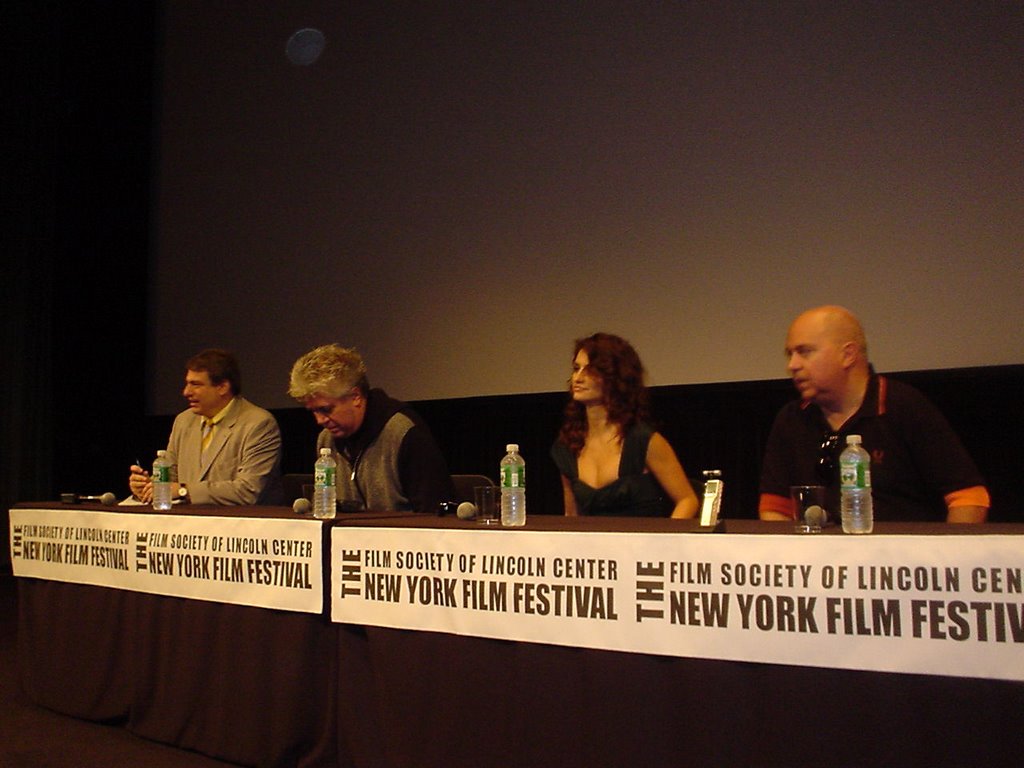
The Go Master press conference at the 44th New York Film Festival

Photo by Martin Tsai. The Go Master director Tian Zhuangzhuang and Film Society of Lincoln Center program director Richard Peña at the Walter Reade Theater in New York City on Sept. 25.

Story to follow.

© Copyright 2006 Martin Tsai. All rights reserved.
September 26, 2006

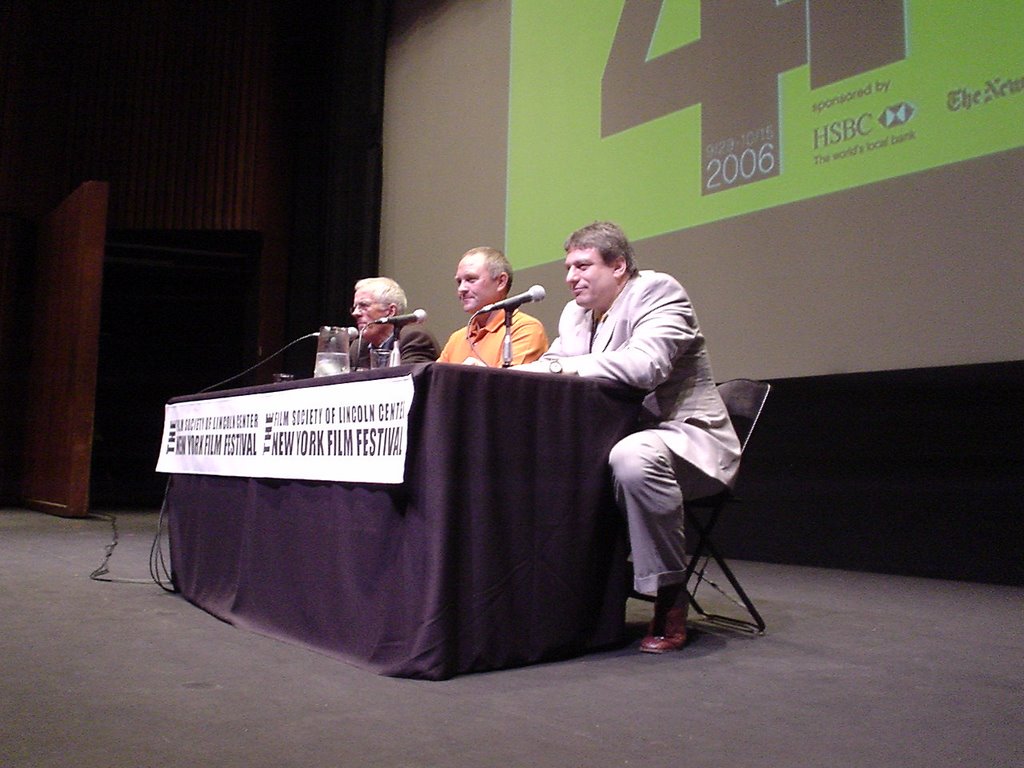
Mafioso press conference at the 44th New York Film Festival

Photo by Martin Tsai. Film Society of Lincoln Center associate director of programming Kent Jones; Carla Del Poggio, widow of Mafioso director Alberto Lattuada; and translator Chiara Carfi at the Walter Reade Theater in New York City on Sept. 25.

Story to follow.

© Copyright 2006 Martin Tsai. All rights reserved.

September 25, 2006

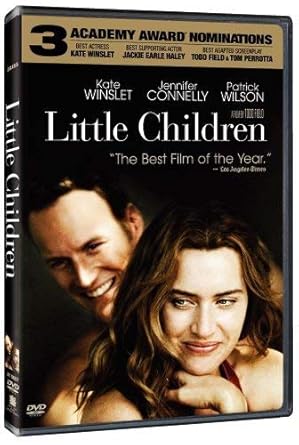
Little Children

Directed by Todd Field Starring Kate Winslet and Patrick Wilson
Reviewed by Martin Tsai
Based on Tom Perrotta’s New York Times bestseller, Todd Field’s long-awaited follow up to his Oscar-nominated In the Bedroom has the potential to be something really magnificent but never quite gets there. To be fair, Little Children is indeed lovely. But a film belonging to this particular breed of exposé on suburban discontent inevitably recalls the likes of The Ice Storm, American Beauty and Happiness even if it doesn’t pale by comparison.
Residents of bucolic East Wyndam, Mass. suddenly get hysterical over a recently-released sex offender (Jackie Earle Haley) moving into the neighborhood. But this frenzy serves only as backdrop to the illicit affair between the overeducated homemaker Sarah (Kate Winslet) and the ex-jock stay-at-home-dad Brad (Patrick Wilson). Sarah must contend with a bratty daughter (Sadie Goldstein) who refuses to sit in her car seat and a husband (Gregg Edelman) who masturbates to Internet porn. Brad’s wife (Jennifer Connelly) highlights unnecessary magazine subscriptions on his monthly credit-card bill. Among the parents who take their kids to the playground and the pool each day, Sarah and Brad are seemingly the only kindred spirits and quickly gravitate toward each other.
Perrotta’s novels share an unmistakable satirical deadpan, and Jim Taylor did a stellar job fleshing that out with his whip-smart screenplay for Election. While Little Children is occasionally very funny, the overall detached and contemplative tone – due to the third-person narration and Field’s direction – strips away the uniqueness of the source material and renders the film somewhat derivative of American Beauty. Little Children also feels a bit telegraphed, with breadcrumb trail foreshadowing all the way to its neatly pieced-together conclusion.
With that said, Field’s new film is still quite a worthwhile experience due to its complex characterizations and its moral ambiguity. The subplot involving Haley’s sex offender Ronnie truly stands out here, to the extent that it eclipses the central plot revolving around Sarah and Brad. In the film’s best-executed scene, Ronnie goes swimming and sightings of him quickly send a wave of panic across the pool. In another powerful scene, his overbearing mother (Phyllis Somerville) confronts a disgraced ex-cop Larry (Noah Emmerich) who has taken it upon himself to chase Ronnie out of the neighborhood. It’s fascinating how the most reviled characters here completely captivate viewers while the readily identifiable protagonists’ midlife crises seem frivolous by contrast.
© Copyright 2006 Martin Tsai. All rights reserved.
Marie Antoinette

Directed by Sofia Coppola Starring Kirsten Dunst
Reviewed by Martin Tsai
Sofia Coppola’s New Wavesque Marie Antoinette gives a rare sympathetic glimpse at the rise and fall of the infamous French queen. The kind of public ridicule Coppola endured after making her acting debut in The Godfather: Part III most likely helps this daughter of a Hollywood monarch identify with Antoinette’s story of a clueless royal reviled by her subjects. As if cautioning the audience on her through-the-rose-colored-glasses subjectivity, Coppola here adopts a predominantly cotton-candy pink mise en scène.
First seen here as a giggling blonde, Kirsten Dunst’s Marie must leave all her Austrian connections (puppy included) behind at age 14 for France to marry Louis-Auguste (Jason Schwartzman), the gawky grandson of King Louis XV (Rip Torn). With international relations on the line, Marie quickly faces the daunting task of producing an heir with the sexually unresponsive Louis-Auguste in order to prevent the annulment of her marriage – a feat that would eventually take her seven years to accomplish. Meanwhile, she finds consolation in a life of excess involving fashion, food and parties to relieve her sexual draught, especially with the lack of adult supervision after Louis XVI’s coronation. With the royalty’s lavish lifestyle and the country’s contribution to the American Revolutionary War, the French people become embittered about the national debt and their own revolution is imminent.
Reminiscent of The Virgin Suicides, Coppola puts together several visually poetic montages – many overflowing with silk, bonbons and gâteaux. Unfortunately, these vignettes seem to really work against the film’s true strength in illustrating Marie’s insular existence. The most memorable scene is a silent shot of a stoic Marie blankly looking out from the balcony, with the telephoto lens rapidly pulling back to reveal the enormity of the palace that represents the oppression she must bear.
Coppola manages to further undermine her own effort by going off on a tangent with Marie’s alleged affair with Swedish Count Alex von Fersen (Jamie Dornan), whom the film characterizes as some kind of a manwhore. Curiously, the co-writer/director leaves out Marie’s imprisonment and decapitation by guillotine, which would be devastating here given Coppola’s sympathetic treatment.
The most notable gimmick in Marie Antoinette is its use of a contemporary soundtrack consisting of bands like The Cure, The Strokes and Air. The film’s attempt at the New Wave feel loses its momentum whenever Coppola half-heartedly trades rock songs and handheld camera for classical music and stately cinematography. This novel concept works well with some of the montages, but becomes laughable when Coppola employs it diegetically – particularly in a ballroom scene. Any of the film’s attempts at authenticity are futile at that point.
© Copyright 2006 Martin Tsai. All rights reserved.
September 23, 2006

Little Children press conference at the 44th New York Film Festival

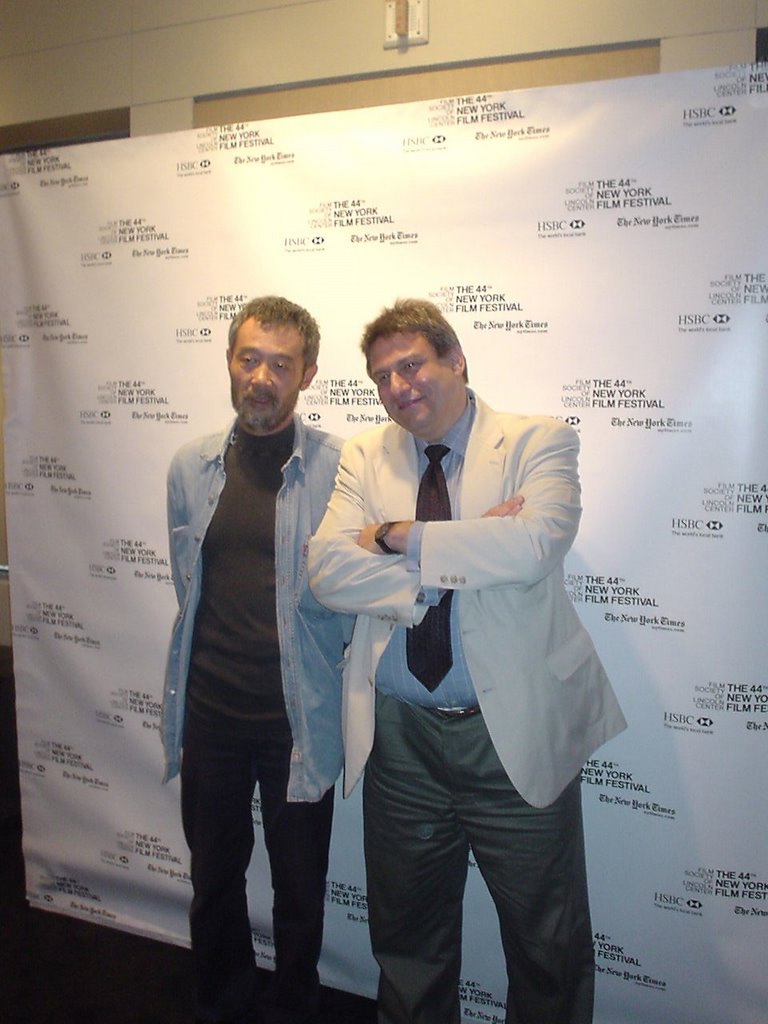
Photo by Martin Tsai. Film Society of Lincoln Center program director Richard Peña, Little Children director Todd Field, stars Kate Winslet, Patrick Wilson, Noah Emmerich and novelist Tom Perrotta at the Walter Reade Theater in New York City on Sept. 22.

By Martin Tsai

“Family life is fascinating to me because that’s what I’ve known for a very long time and because there is so much drama and melodrama in family life. Things that happen in my household are mind-boggling to me,” Todd Field said. The director/co-writer of the Oscar-nominated In the Bedroom returns after a five-year hiatus with the big-screen adaptation of Tom Perrotta’s bestseller Little Children. With these two films, Field has already established a knack for the domestic relations milieu. Set in a suburb startled by the recent arrival of a newly-released sex offender, Field’s latest effort focuses on the unraveling lives of several families.

“There have been many fine movies of late that deal with – specifically in fine detail – characters with this kind of behavior as a whole film, and those are hard films for me. I have three children and I don’t really want to see that sort of thing,” Field said. “I always looked for reasons to say ‘no, I’m not gonna do this’ and I couldn’t. Its voice was so strong and it affected me in a way that I probably didn’t fully understand.”

The complex drama also attracted Kate Winslet in spite of the fact that she too grappled with its subject matter. “I was initially very hesitant to even read it, because I knew that there was this sex-offender character within the piece. One would just have an extremely powerful allergic reaction to that initially as an actor,” she said. “And then I knew it was Todd whom I had admired for a long time and also Tom. After Election and etc., I was very aware of the book. Then I read the script, and I not only really, really loved the script, the story and the dialogue, it was just so seamless somehow.”

Field credits Perrotta’s observant characterizations, as well as his “very sharp, very funny, and also appropriately kind” writing voice that has eased his qualms about the controversial subject matter. “Part of what struck me when I read Tom’s book about this character is that he is everybody’s nightmare. He is a receptacle to this whole form of McCarthyism by this community based on hearsay, and based on one man’s accusations in which this entire community turns against this man and his mother. We don’t really know what he’s done. We know there are things he’s battling with, but he is also in many ways more upfront about what his problems are than these other characters.”

The film features the relatively unknown Patrick Wilson and Jackie Earle Haley in two of its meatiest roles. Haley won the challenging part of sex offender Ronnie after an equally unconventional audition, and Winslet also gave him a raving recommendation. “When you think about a role like that, probably many people would have the same five ideas, and I heard them over and over and they were all good actors. But it was important that whoever played this role be somebody who wasn’t on that top-of-the-head list, but I had no idea who that would be,” Field said. “I came back to the hotel one night and there was a tape sitting there. It was from Jackie Earle Haley. So now he had gotten his hands, I don’t know how, on a very, very early draft of the script. He had made a short 20-minute film as this character. It was rather daunting actually, because Jackie for the last several years has been making his living as a regional commercial director. So you get tracking shots in this very involved thing. And I thought, oh Lord, this guy can really direct!”

Perrotta said the actors help fill in many blanks in the script, especially when many of their characters’ backstories in the book aren’t part of the shooting script. “There’s a lot of the book that just by default has to get lost. It’s a 350-page book with seven main characters. I think the interesting issue for Todd and I when we were writing the script was how to deal with the past and the whole background. The book actually begins with character sketches, and you really know a lot about who these characters are by the time you meet them,” he said. “What happens is somehow actors in their physical presence imply a past. I was surprised how little that stuff that was essential in the novel needs to be there. There was this ghostly presence of the past that just lingers around these characters.”

Despite all the acclaim that In the Bedroom received, Field said he had a tough time getting another film off the ground until he came across Little Children. Conveniently, his producers had already collaborated with Perrotta on Election which gave him first dibs on the novel.

“The strange thing for me is, you make a film, it goes out, and has a life of its own completely separate from you. And I think there’s a natural assumption, I certainly have this, that it will be easier to make another film. That simply isn’t true,” he said. “I spent five years trying to get another film going. I’ve not been able to get backing for kitchen-sink dramas. I’ve written scripts that no one wants to make. When I found this book of Tom’s, I wanted to make it like I wanted to make other things. I was just fortunate to have somebody that said ‘yes, let’s make the film’.”

© Copyright 2006 Martin Tsai. All rights reserved.