October 22, 2006

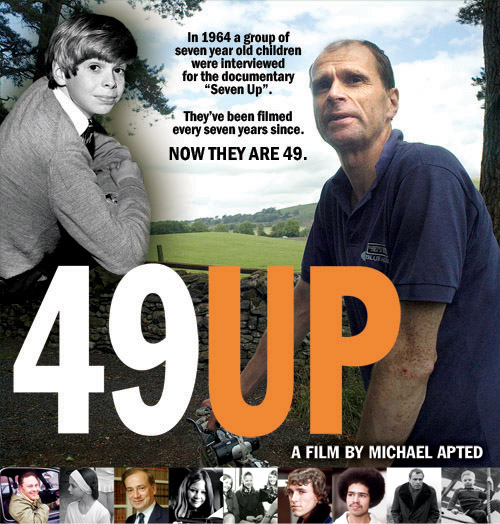
49 Up

Directed by Michael Apted

Reviewed by Martin Tsai

Exploring the impact of class difference on the lives of 14 seven-year-old school children, the groundbreaking 1964 documentary Seven Up! became a cultural landmark in its native England when it first aired. Director Michael Apted has been documenting those lives ever since, following up on them every seven years with a new installment. Through the various films, viewers witness each participant’s innocent childhood, carefree adolescence, hard-fought adulthood, and painful midlife crisis.

The latest, 49 Up, is the first to hit American shores. The 12 subjects (two of the original 14 dropped out in their 20s) have all pretty much given up their lofty ambitions, reconciled with past troubles, and settled for life’s rewards on a relatively lesser scale. Juxtaposing current looks at the 12 with archival footage from previous installments, the film puts life – both theirs and ours – in perspective. It shows how one can turn from a chubby-faced child to a wrinkled grandparent quite literally in a flash.

John and Andrew went to the pre-prep school and predictably grew up to be barristers. Working-class Jackie and Sue went through jobs and marriages, and became single parents. Bruce showed an early sensitivity toward poverty and racial issues, and wound up teaching kids in Bangladesh. Tony failed at being a jockey in his youth and did a string of odd jobs. Nick transcended his early years on the farm and became a nuclear physicist in the States. Neil was unemployed and homeless throughout his 20s and 30s, and later recovered to become a district councilor. It’s mind-boggling to see how some of them remain essentially the same people and achieve their childhood goals, while others have weathered life and emerge completely different.

What started out as a commentary on the class system has morphed into something far more profound. No class is immune from failed aspirations, broken marriages and the joys of parenthood and grandparenthood. The film’s social commentary reaches even further beyond the lives of its subjects: As they move into posh suburbs or promised foreign lands, East Indian immigrants have taken over their old East End neighborhood.

The film is also no longer Apted’s. Feeling that the series has invaded their privacy and their dirty laundry has become water-cooler gossip, many participants start to take the reins of their own narratives by withholding information or questioning the voyeuristic nature of the project. Some of them pointedly accuse Apted of projecting his middle-class worldview onto the series, while others suspect an ulterior motive behind his questions.

Objectively, one can argue that Apted is in a way still projecting his own view in spite of his objects’ attempt to exert control over the depiction of their lives. The 65-year-old filmmaker is possibly facing the issue of mortality, and 49 Up seems to be putting more emphasis on children and family life. But it’s also possible that this entire generation has already fought its battles, and they now just want to live out the remainder of their lives in comfort and contentment.

There are few documentaries or even dramatic films that are able to articulate life quite like 49 Up. This is not just a slice of life, but life in its entirety. Encompassing class, money, marriage, sex and parenthood, the film tells the story of the post-war, baby-boomer generation like few others could. In the age of the so-called reality television when people mug for the camera and blow the most insignificant thing out of proportion, 49 Up reminds us that pure, unadulterated reality is truly quite a spectacle to behold.

Reprinted from EmanuelLevy.com. © Copyright 2006 Martin Tsai. All rights reserved.

October 14, 2006

Marie Antoinette press conference at the 44th New York Film Festival

Photo by Martin Tsai. Marie Antoinette director Sofia Coppola and star Kirsten Dunst at the Alice Tully Hall in New York City on Oct. 13.

By Martin Tsai

“I didn’t know very much about her, except for this iconic decadent evil queen. When I started reading about her, I was struck by how young she was. She was this 14-year-old kid. I read about the side that is a real person, who had a lot of sympathetic qualities as well as flaws,” Sofia Coppola said of Marie Antoinette. “I wanted to make an impressionistic view of her. I wanted all the music to reflect emotions the character was having at that time. I wanted to take the adults in the court and the music of the period and then contrast that with the world of the teenagers and the more contemporary music that shows the energy.”

Since its debut at the Cannes Film Festival, Coppola’s Marie Antoinette has met a lukewarm reception in France. But the film gets a second chance in the States, where it premieres at the prestigious New York Film Festival. At the press conference, Coppola seemed less interested in talking about her use of contemporary music in a period piece. She became more engaging and articulate only when she had to defend some of her historical choices rather than artistic ones.

“There are so many elements, we couldn’t put every single thing in … We couldn’t go into every area because it was an impressionistic portrait,” Coppola responded when journalists asked her why she chose not to show Marie Antoinette’s decapitation and glossed over her illiteracy.

“The story after they leave Versailles is a long period of 10 years in prison and a long trial and then escape,” she said. “We weren’t making a miniseries so I couldn’t tell that whole story. I decided to focus on the years in Versailles prior to her departure, to show that she evolved and became a woman.”

Kirsten Dunst, who plays the title role, finds Coppola’s method is more rewarding to her as an actress than the textbook approach. “Already I knew this would be something different from how I would normally approach a historical figure. (Coppola) forced me to look at her in such a personal way that I had never looked at somebody in history before. There are so many facets about Marie Antoinette. I could have the freedom of my own in trying to find the essence of her, not judge her, and understand her point of view as a woman at whatever stage she might be in.”

Coppola said it was thrilling for the cast and crew to be able to film on location in Versailles, especially in the museum’s private areas. The only issue was for her producer Ross Katz to schedule the filming, since the museum is open to the public most of the time.

“It was a very scary thing going to France and not knowing we would have permission to shoot in Versailles,” Katz said. “After one meeting with the current head of Versailles – the director general of the palace – he said that he was going to open the gates to the palace so we would be able to tell the interior life of the character. From that point on they were with us every day to film at a place that has spoken to millions of people.”

© Copyright 2006 Martin Tsai. All rights reserved.

October 10, 2006

Triad Election press conference at the 44th New York Film Festival

Photo by Martin Tsai. Film Society of Lincoln Center program director Richard Peña, Triad Election director Johnnie To and producer Dennis Law at the Walter Reade Theater in New York City on Oct. 9.

Story to follow.

© Copyright 2006 Martin Tsai. All rights reserved.

These Girls press conference at the 44th New York Film Festival

Photo by Martin Tsai. These Girls director Tahani Rached and New York Film Festival seection committee member Phillip Lopate at the Walter Reade Theater in New York City on Oct. 9.

Story to follow.

© Copyright 2006 Martin Tsai. All rights reserved.
October 07, 2006

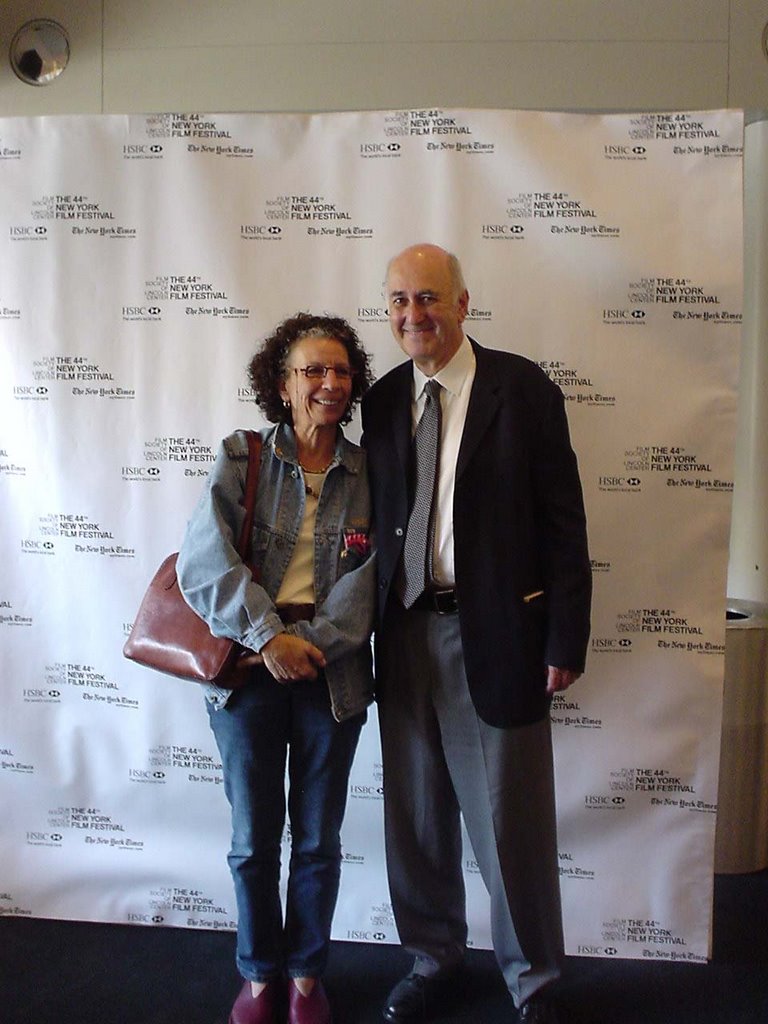
Inland Empire press conference at the 44th New York Film Festival

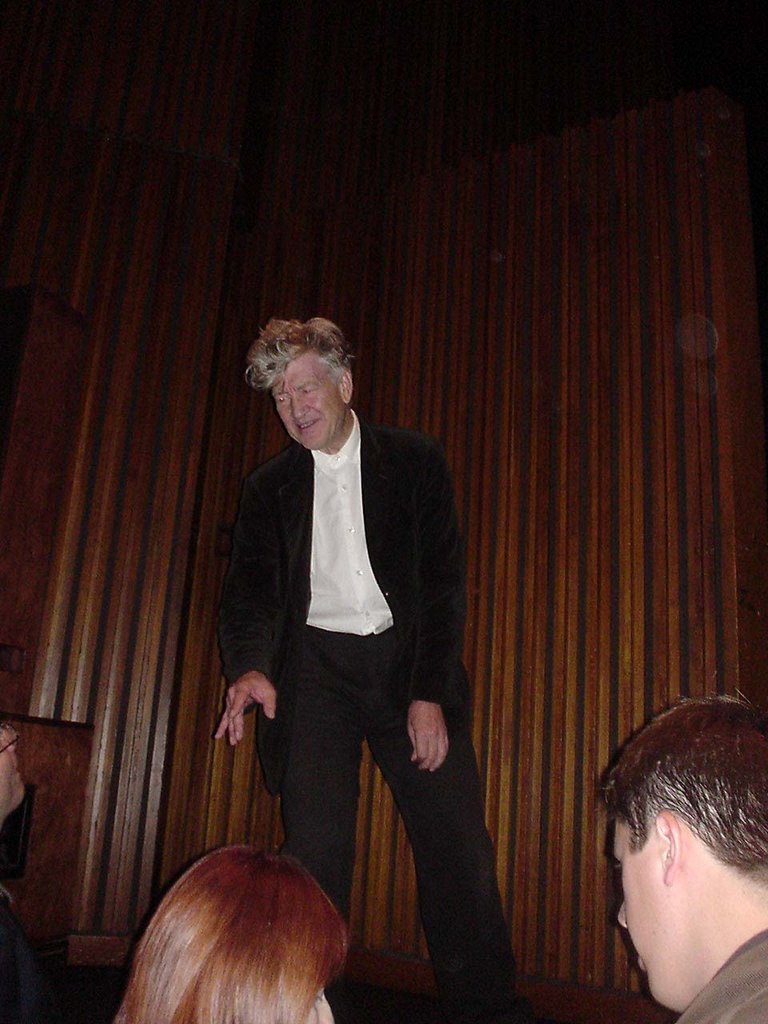
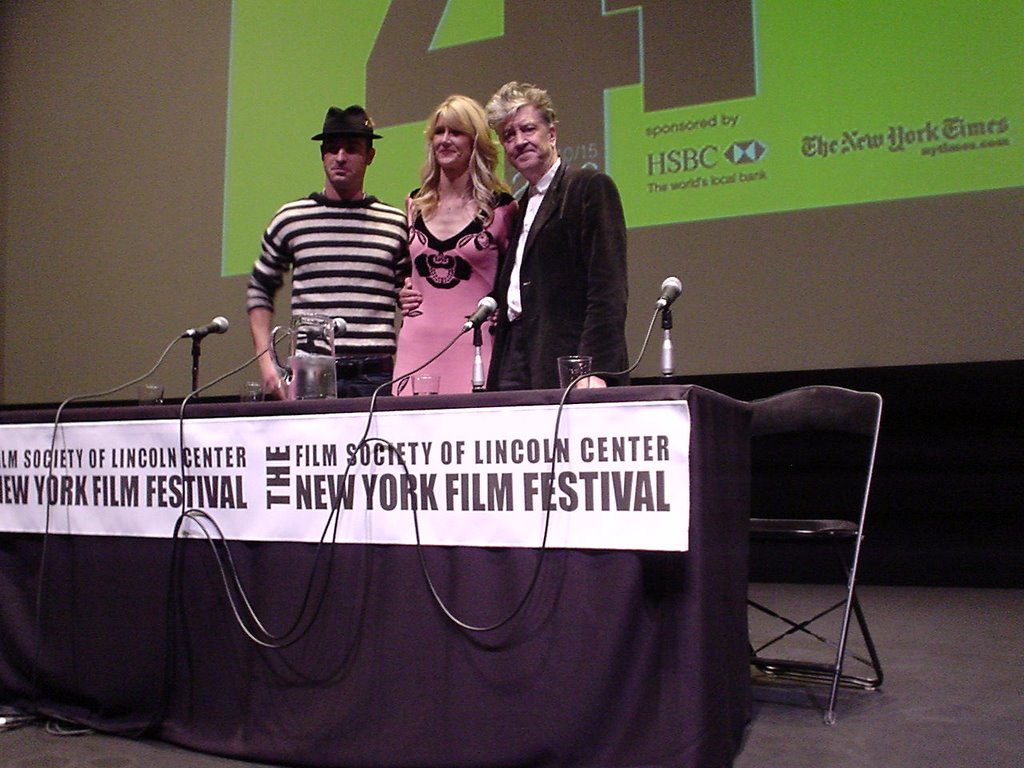
Photo by Martin Tsai. Inland Empire stars Justin Theroux, Laura Dern and director David Lynch at the Alice Tully Hall in New York City on Oct. 6.

Photo by Martin Tsai. Inland Empire director David Lynch at the Alice Tully Hall in New York City on Oct. 6.

Story to follow.

© Copyright 2006 Martin Tsai. All rights reserved.

Falling press conference at the 44th New York Film Festival

Photo by Martin Tsai. Film Society of Lincoln Center associate director of programming Kent Jones, Falling director Barbara Albert and star Gabriella Hegedûs at the Walter Reade Theater in New York City on Oct. 6.

Story to follow.

© Copyright 2006 Martin Tsai. All rights reserved.
October 05, 2006

Terry Gilliam at IFC Center

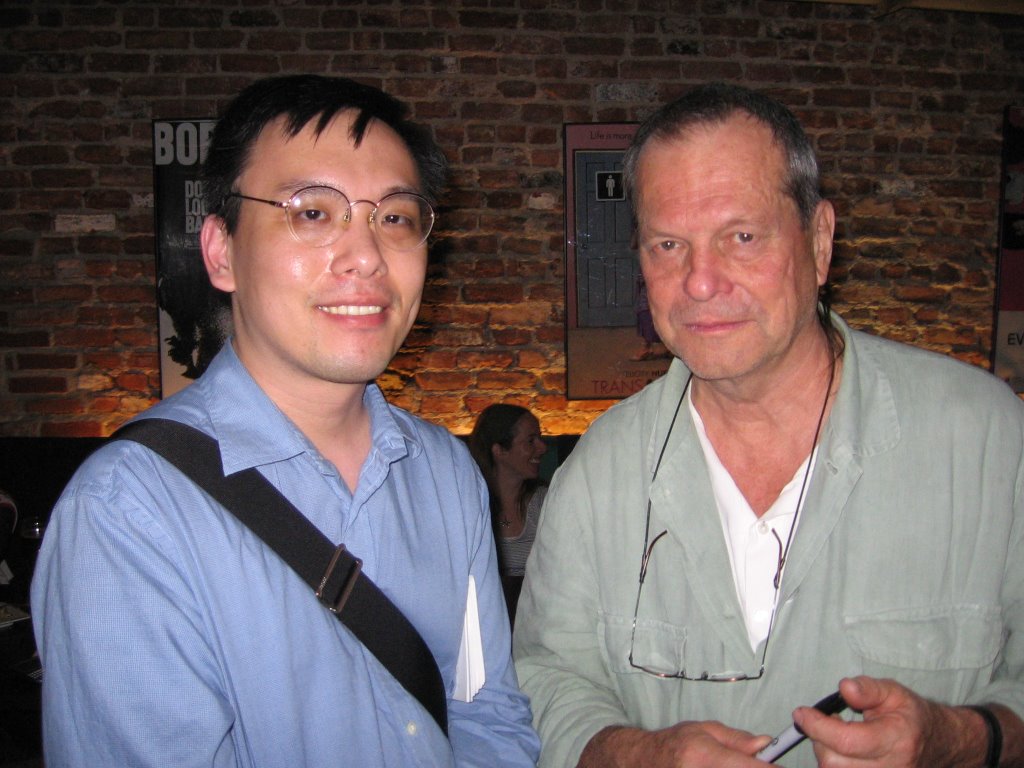
Photo courtesy of Bobby Miller. Martin Tsai and director Terry Gilliam at the IFC Center in New York City on Oct. 4.